The high-resolution photogrammetric, thermal, and LiDAR data captured by drones is sensitive data. For government and infrastructure operators, this data is a core operational asset. Its exposure on public cloud servers, which can be subject to outages or external access, presents an unacceptable security and compliance risk.
In response, the industry is moving decisively toward localised, “air-gapped” solutions. This development signals a maturation of the market, prioritising security and operational control over simple connectivity.
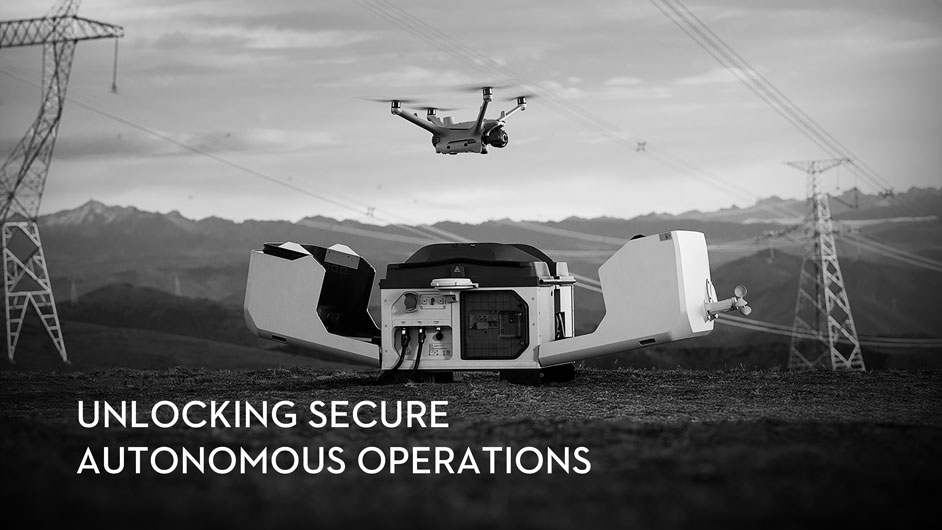
The pivot to on-premise solutions is a critical enabler for the next generation of drone technology: autonomous, “drone-in-a-box” systems. These docks, designed for 24/7 readiness, rely on a constant connection to a management platform to execute pre-programmed missions and provide real-time site awareness.
For the sensitive sites that benefit most from this automation, like ports, substations, and solar farms, using a public cloud is not a viable option. It would mean streaming a live feed of their most secure locations to an external server.
A private, on-premise platform like the DJI FlightHub 2 resolves this conflict. It allows these autonomous docks to be deployed within a completely “closed-loop” network. The dock can execute automated inspection routes, stream live video, and upload data, with every piece of information remaining inside the organisation’s firewall. This makes fully automated, secure remote operations a reality.
In the past, organisations faced a difficult choice: adopt a feature-rich cloud platform and accept the data risk, or choose a secure on-premise solution that was often basic, slow, and lacked real-time collaborative tools.
Modern on-premise platforms, such as the FlightHub 2, have eliminated this gap. Users no longer have to sacrifice functionality for security. The full suite of advanced fleet management tools is now available for private, local deployment.
The DJI FlightHub 2 provides a single source of insights for an entire operation, all hosted internally.
Key features now include:
Real-Time Situational Awareness: A unified dashboard provides a live overview of all pilots, drones, and autonomous docks.
Collaborative Mapping: Team members can create live annotations on maps, share points of interest, and track targets, with all changes synced instantly to every operator on the private network.
Localised Data Processing: Powerful processing engines, powered by an organisation’s own hardware, can rapidly create high-resolution 2D maps and 3D models from drone data. This critical function, once heavily reliant on the cloud, can now happen securely in-house.
Simplified Deployment: This technology is also more accessible. Instead of complex, custom IT projects, organisations can now use integrated, all-in-one hardware solutions that come pre-configured with the on-premise software, allowing for rapid deployment in a server room or even a mobile command vehicle.
The complexity of setting up and maintaining private servers has been a significant barrier to adoption. New hardware solutions, like the DJI AIO (All-in-One), are engineered to eliminate this IT challenge. These devices combine hardware and software into a single, pre-configured unit.
This “out-of-the-box” approach comes pre-installed with the complete on-premise operations platform and a local cloud modelling module. This integration provides powerful capabilities with minimal setup. It allows for rapid 2D and 3D reconstruction using its own built-in processing power.
Its design also allows for flexible deployment, operating effectively in a server room, a standard office, or even a mobile command vehicle for emergency response missions. This hardware simplifies maintenance with features like mirrored data storage for reliability and simple, visual operation dashboards, making secure, high-level fleet management accessible without a dedicated IT team, all the while keeping your drone data secure.
This move to on-premise control does not mean creating a “locked box.” The new generation of private platforms is designed for deep integration with existing enterprise systems.
Through an open API, organisations can connect the drone platform directly to their own software, creating custom workflows. For example, data from a drone inspection can be automatically fed into an existing asset management system. Support for single sign-on (SSO) allows IT departments to manage user access through their existing authentication protocols, streamlining security and operations.
Modular components, like virtual cockpits or flight route editors, can also be integrated directly into an organisation’s proprietary dashboard. This allows enterprises to build a single, unified interface for all operations, with the drone management platform running securely in the background.
This move toward powerful, on-premise systems provides the technical framework for the next phase of enterprise drone adoption. It allows security-conscious organisations to scale their operations, manage autonomous systems, and process vital data without compromising their security posture.
To learn more about integrating a fully on-premise fleet management system for your drone operations, get in touch with us today.